
HSE Myth Buster
Issue
Enquirer’s mum is registered disabled and whilst in their village pub her mum needed to use the disabled toilet. When she came out, she asked the landlady why there wasn't a mirror in the toilet. The landlady stated that it was for health and safety reasons.
Panel decision
It is ridiculous to suggest that a mirror cannot be provided in a disabled toilet for “health and safety” reasons. This is clearly not the case given that British Standards even specify how mirrors should be positioned to meet the needs of disabled people. The contractor who refurbished the toilet clearly used “health and safety” as an excuse to cut costs and the landlady appears to be happy to pass on this feeble excuse to customers.
Construction inspections find sites failing to prevent health risks
A national targeted inspection focussing on health risks for construction workers saw enforcement action taken at one in six of hundreds of sites visited.
During a concentrated two-week period of proactive inspections, the Health and Safety Executive (HSE) demanded improvements, and in some cases put an immediate stop to work activities, where they fell short of expected standards.
Inspectors focussed on significant health risk issues, such as respiratory risks from dusts containing silica materials, exposure to other hazardous substances such as cement and lead paint, manual handling, noise and vibration.
Final figures have yet to be confirmed, but conditions were so poor in some situations that the work had to be stopped on at least 13 occasions.
A total of 560 sites were visited and enforcement notices were served at 85 of them. Thirteen Prohibition Notices were served (where certain work or practices must be stopped until improvements are made), and 107 Improvement Notices. A total of 239 health-related Notices of Contravention were served at 201 of the sites.
HSE’s Chief Inspector, Heather Bryant, said:
“We recognise the construction sector’s progress in reducing the number of people killed and injured by its activities. But it is clear from these figures that there is an unacceptable toll of ill-health and fatal disease in the industry.
“So, to encourage the industry to treat health issues in the same way as safety, HSE’s inspectors will consolidate the efforts of this initiative throughout the rest of the year by looking at the prevention and control of health risks in construction, alongside their continued assessment of the management of safety risk issues.
“We will make sure the construction industry ‘Thinks health’ as well as safety.”
Costain sentenced for Parkway telehandler death
Global engineering specialist Costain Limited has been ordered to pay more than £615,000 in fines and costs after a worker was killed when a telehandler overturned during the construction of the Parkway development in Newbury.
Mark Williams, 41, from Nuneham Courtenay, was using the vehicle to lift a pallet of tiles to a fourth story roof when the incident happened on 20 July 2011.
He tried to flee the telehandler as it began to topple, but he was unable to move away in time and it landed on top of him, causing fatal crush injuries.
His death was investigated by the Health and Safety Executive (HSE), which found the safety of the vehicle was compromised by limited space and other obstructions in the area where he was required to work.
Costain Limited, the principal contractor for the Parkway development, was prosecuted for failing to provide a safer system of work.
Reading Court heard during a five week trial earlier this year (from 3 March 2014) that Mr Williams, a married father-of-two, was part of a team responsible for tiling a number of roofs.
He was operating the telehandler with the boom fully raised but not extended. Raising the boom reduced the overall length of the vehicle, however it ultimately caused it to overbalance as it was being turned and manoeuvred.
HSE inspectors established that Mr Williams had no option but to operate the vehicle in this way. The space between the buildings where he worked was almost the same length of the telehandler with the boom lowered, and meant he would have had no turning circle.
The court was told the vehicle was not suited for use in this area, and that had the space constraints been properly assessed and a better system of work put in place then Mr Williams death could have been avoided.
Costain Limited, of Costain House, Vanwall Business Park, Maidenhead, was fined a total of £525,000 and ordered to pay a further £90,577 in costs after being found guilty of breaching Sections 2(1) and 3(1) of the Health and Safety at Work etc Act 1974, and two breaches of Regulation 3 of the Management of Health and Safety at Work Regulations 1999.
After sentencing HSE principal inspector Steve Hull commented:
“This was a tragic and entirely preventable death. Mark Williams was required to use a telehandler that was wholly unsuited to the confined area he worked in.
“He had no option but to raise the boom so he could turn the vehicle, and in doing so he critically undermined the stability, resulting in the inevitable overturn.
“He should have been provided with alternative, more appropriate equipment and a better system of work. Costain had clear responsibilities to ensure that happened, but they failed to properly assess the risks and ultimately failed Mr Williams.”
Shenda Long, Mark’s mother, added: “I have always felt that I have lived a very privileged and happy life, but all that changed on 20 July 2011 when police officers knocked on our door and informed me that our beloved son had been killed.
“Mark was a loving son, brother, partner, friend and an amazing dad to his two daughters who brought sunshine, happiness, joy, laughter and love into our family.
“Little did we know that fateful day that it would be the last morning we would feel peaceful, happy and complete. How could we know that the simple act of Mark going to work, as he done every day for years, would result in him being killed, and my family’s world ending.
“Mark was totally let down by the people he worked for and trusted.”
Mr Williams’ employer, Attley’s Roofing Limited, was earlier cleared of identical health and safety breaches at the end of the initial trial on 3 April. The company, of Spital Farm, Thorpe Mead, Banbury, was acquitted after being jointly prosecuted by HSE alongside Costain.
Construction firm and roofing director prosecuted following worker fall
A London construction company and the director of a Hertfordshire roofing firm have been fined for safety failings after a worker was seriously injured when he plunged almost six metres through a void for a roof light.
The self-employed roofer, who does not want to be named, broke and fractured several bones in his back and bruised his diaphragm, lungs and thigh in the incident in Brent on 29 February 2012. He was unable to work for 14 months and still requires hospital treatment for back problems that have forced him to seek alternative employment.
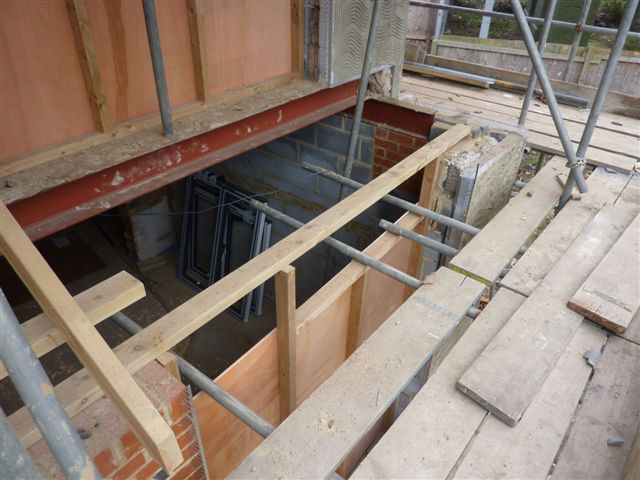
The roof light void where the fall occurred
The fall occurred while he was under the control of Rickmansworth-based John Donald, trading as John Donald Roofing. The director had in turn been sub-contracted to undertake some of the roof work by Golders Green-based Right Angle Ltd, the principal contractor for a project that involved refurbishing and extending three residential properties.
The Health and Safety Executive (HSE) prosecuted both parties after identifying a number of safety failings across the site as well as those linked to the roof work.
Westminster Magistrates Court heard that the injured worker, then aged 28, fell as he cleared materials from a flat roof. He picked up a piece of ply board that he assumed was debris without realising it concealed a roof light void beneath.
He fell feet first through the void and landed on the first floor some 5.6 metres below, fracturing his spine on impact.
HSE established that the measures taken to mark and protect this and other similar voids were totally unacceptable, and that any number of workers could have suffered a similar fate.
Further failings included fall risks in other locations at the site, such as the edges of the flat roofs where there was no edge protection, fall risks on the scaffold, open joists, and open staircases where there were no handrails.
Other issues were also identified across the site, including fire risks and inadequate fire prevention measures; numerous slip and trip hazards caused by excess rubbish and debris; and glazed window frames stored upright and unsecured that were liable to fall and cause injury.
The court was told the fall was entirely preventable had the void been clearly marked and better protected, which was the responsibility of both defendants, and that moreover Right Angle had failed to properly plan, manage and monitor the construction phase.
Right Angle Ltd, of Finchley Road, London, NW11, was fined £15,000 and ordered to pay full costs of £5,375 after pleading guilty to a single breach of the Construction (Design and Management) Regulations 2007.
John Donald, of New Road, Croxley Green, Rickmansworth, was fined £4,000 with £3,965 costs after admitting a breach of the Work at Height Regulations 2005.
After the hearing HSE Inspector Danielle Coppell said:
“There were numerous failings on the part of Right Angle Ltd that exposed multiple operatives to a host of foreseeable risks, including falls, slips and trips.
“John Donald has to accept culpability as an experienced roofer who should have known better. He instructed the injured worker to work in an unsafe area where there were wholly insufficient measures in place to prevent or mitigate a fall.
“The end result is that a young man has sustained life-changing spinal injuries from which he may never fully recover.”
Five in court for multiple safety failings
A Lincolnshire poultry firm and four of its contractors have been fined for repeated safety failings after workers were caught on a roof without taking proper safety precautions.
GW Padley Poultry Ltd were prosecuted by the Health and Safety Executive (HSE) after inspectors witnessed unsafe working at height while building a poultry shed at the company’s site in Wigtoft, Lincolnshire, in March 2012.
The poultry firm was the principal contractor but had no representatives on site. The poultry buildings were supplied by Harlow Bros Ltd of Loughborough, who sub-contracted the erection of the buildings to K & M Tomlinson Ltd, and Philip Bates.
Lincoln Crown Court was told that HSE visited the site on 13 March 2012 and saw four workers on the roof of a new poultry building. There was no edge protection or scaffolding in place and the height of the gable roof was about six metres.
When the inspector asked the workers to come down, they had to walk about ten metres along the sloping roof and down an unsecured ladder. The inspector issued Kenneth Tomlinson, director of K & M Tomlinson, with a Prohibition Notice, stopping further work on the roof until suitable edge protection was put in place.
When the inspector revisited the site three days later, work on the roof had been completed. A tower scaffold was at one end of the eaves and 12 airbags were on the floor at the other end of the building, but there was still no edge protection.
The inspector returned later the same day with a colleague and found workers, including Philip Bates, on the roofs of two sheds. The scaffold tower seen earlier had been dismantled.
HSE found airbags used for cushioning a fall were loose and anyone falling would have hit the ground. Faults were also found with a forklift truck being used in conjunction with work platform fitted to its prongs. A second Prohibition Notice was served, preventing further work on the shed roofs.
Further enforcement notices were issued to GW Padley Poultry, Harlow Brothers and Mr Bates to prevent all work on sloping roofs until adequate edge protection and internal fall protection was provided and an Improvement Notice was served on the poultry firm requiring them to appoint a competent site manager.
Harlow Brothers put in place a lifeline and harness system for safe working at height, but this was found to be inadequate on inspection and a further Improvement Notice was served.
The court heard that Harlow Brothers Ltd and Philip Bates have previous convictions for work on poultry house roofs without edge protection.
GW Padley Poultry Ltd of Mount Street, Nottingham, pleaded guilty to breaching regulation 22(1)(a) and regulation 22(1)(c) of the Construction (Design and Management ) Regulations 2007 and was fined £9,000 and ordered to pay £15,000 costs.
Harlow Brothers Ltd of Long Whatton, Loughborough, Leicestershire, pleaded guilty to breaching Section 3(1) of the Health and Safety at Work etc Act 1974 on two separate occasions, the 13 and the 16 March 2012 and Section 4(2) of the Provision and Use of Work Equipment Regulations 1998 and was fined £30,000 and ordered to pay £15,000 costs.
K&M Tomlinson Ltd of Nottingham Road, Long Eaton, pleaded guilty to breaching Sections 2(1) of the Health and Safety at Work etc Act 1974 and Section 5(1)(a) of the Lifting Operations and Lifting Equipment Regulations 1998, and was fined £1,000.
Kenneth Tomlinson of College Street, Long Eaton, pleaded guilty to breaching Section 3(1) by virtue of section 37 of the Health and Safety at Work etc Act 1974 and was fined £1,000 and ordered to pay £3,000 costs.
Philip Bates of The Square, Leasingham, Lincolnshire, pleaded guilty to breaching Section 3(2) of the Health and Safety at Work etc Act 1974 and was fined £4,500 and ordered to pay £5,550 costs.
After the hearing, HSE inspector Martin Waring said:
“In this case there was clear evidence of a very poor attitude to health and safety generally on this site. Each of the defendants had clear duties to ensure the safety of the workers, however these were repeatedly ignored.
“Working at height poses very obvious dangers but our visits uncovered a catalogue of safety breaches which could have had led to a fatal or very serious injury for a worker had they fallen.
“There was a continued and deliberate neglect of duties by particular parties in this case; and directors who disregard their responsibilities will be held personally accountable.”
Crawley builder prosecuted for gas safety breaches
The senior partner of a building firm in Crawley has been sentenced after carrying out illegal and incompetent work on gas fittings and exposing a local family to the dangers of fire or explosion.
Sunil Vadher was one of two brothers running SR Brothers building firm, which had been hired to build an extension at the family’s home in Broadfield, Crawley. As part of the contract the brothers carried out gas work involving installing a new boiler and pipework for a gas cooker.
The couple, who have three children, had several problems with the boiler and decided to have the gas installations checked after SR Brothers had stopped their construction work at the property.
An inspection by Gas Safe Register, the professional body for registered gas engineers, found two defects classed as ‘immediate risk’, four ‘at risk’ and a further six that were found to be below current standards.
The findings were passed to the Health and Safety Executive (HSE) which prosecuted Sunil Vadher for three breaches of the Gas Safety (Installation and Use) Regulations 1998 and a breach of the Health and Safety at Work etc Act 1974 committed between July 2013 and February 2014.
Crawley Magistrates heard the Gas Safe investigator had isolated the family’s gas supply as some of the work carried out left it too risky to use. HSE issued a prohibition notice on both the brothers preventing either from carrying out any gas work until they were competent and Gas Safe-registered.
HSE told the court that although SR Brothers was a partnership, Sunil Vadher was effectively in charge.
Sunil Vadher of Marion Road, Furnace Green, Crawley, West Sussex, was fined a total of £1,000 and ordered to pay £870 in costs after admitting the four offences.
After the hearing, HSE Inspector Stephen Green said:
“Despite knowing that gas work can only be carried out by Gas Safe-registered engineers, Sunil Vadher chose to undertake the work himself to save money. In doing so, he exposed a couple and their three children – and anyone else in the immediate area – to a risk of fire and explosion.
“The family was also exposed to risks of asphyxiation and carbon monoxide poisoning.
“Sunil Vadher compounded the deception by providing the family with a boiler commissioning checklist, fraudulently using the details of a Gas Safe-registered installer, to intentionally mislead them into believing the work had been professionally signed-off.”
Illegal gas work puts lives at risk, with around one in five jobs investigated by the Gas Safe Register found to be immediately dangerous. Only Gas Safe registered engineers should be used to fit or fix gas appliances, whether in a domestic or commercial property. Every registered engineer has an ID card which shows who they are and the type of work they are qualified to carry out
Kent firm in court after decade of ignoring risks to workers
A Ramsgate company has been sentenced after one of its employees was left with a severe long-term disability following prolonged working with a range of vibrating machine tools.
A further four employees of Cummins Power Generation Ltd were also diagnosed with symptoms consistent with early stage Hand Arm Vibration Syndrome (HAVS), a debilitating condition that cannot be reversed.
The firm was prosecuted for safety breaches after the Health and Safety Executive (HSE) was made aware of the high incidence of HAVS among its staff.
Canterbury Magistrates’ Court heard that Cummins Power Generation had failed to manage the exposure of their employees to the serious risks of vibration for more than ten years.
As a result one employee in particular was diagnosed with advanced HAVS in both hands. Although he still works with the company he has to ask for the help of a colleague whenever a task requires the use of a hand-held power tool. He is also unable to enjoy previous hobbies of golf or swimming.
HSE found the company failed to assess their workers’ level of exposure to vibration until HSE began its investigation. By this time some employees were either at or beyond the trigger levels for developing symptoms. The firm also failed to put preventative measures in place until HSE served an improvement notice.
Cummins Power Generation Ltd, Columbus Avenue, Manston, Ramsgate, Kent, was fined £20,000 and ordered to pay £49,149 in costs after admitting a breach of Section 2(1) of the Health and Safety at Work etc Act 1974.
After the hearing, HSE Inspector Alison Benfield said:
“HSE guidance on HAVS was published as long ago as 1994 so vibration risk has been widely known for many years – ‘white-finger’ was a common industry term for HAVS. Cummins Power Generation failed to manage this risk over a significant period of time, from early 1998 to early 2009, across its sites in both Ramsgate and Margate.
“Hand-arm vibration can have a significant impact on a worker’s health. If the use of power tools is not controlled correctly by engineering and manufacturing companies, workers can develop HAVS to a degree that will have a permanent disabling impact on their working and social lives.
“Measures can include purchasing tools with the lowest vibration levels, introducing better systems of work when possible to avoid exposure all together, making sure workers know how to use tools properly and regular health surveillance to detect any early signs.”
Firm sentenced after forklift truck ran over worker’s leg and foot
An Aberdeen firm has been fined for safety failings after a worker was injured when a forklift truck ran over his leg and foot.
Derek Bonnar, 51, from Aberdeen, was working for Scotoil Services Ltd at its premises in Miller Street when the incident occurred on 17 August 2012.
Aberdeen Sheriff Court was told that Mr Bonnar was one of four men working in two teams to pressure-wash naturally-occurring radioactive material from components in two large wash bays, both in a restricted zone on site.
At one stage Mr Bonnar was working alone cleaning down one of the bays when a colleague from the second team returned driving a forklift truck. While the driver reversed the forklift and then moved forward to load components, Mr Bonnar was walking backwards while hosing down the next bay. The truck collided with Mr Bonnar, driving over his left leg and right foot.
Mr Bonnar suffered a broken leg and fractures to his foot. He spent a week in hospital and a further seven weeks in a wheelchair. He has since returned to work.
An investigation by the Health and Safety Executive (HSE) found Scotoil had failed to provide sufficient segregation between pedestrians and vehicles in the restricted zone. It also failed to provide sufficient instructions to control vehicle movements in the area while pedestrians were working.
Scotoil carried out its own investigation into the incident and made a number of recommendations. However, no changes had been made to the system of work or the physical layout of the site when HSE visited six weeks after the incident. HSE issued a Prohibition Notice preventing the use of vehicles in the area until a safe system of work had been implemented so vehicles and pedestrians could work together safely.
The court heard there had been a similar incident a year earlier, in 2011, when a Scotoil employee was injured when he was struck by a forklift truck which was reversing within a building on the site. HSE took enforcement action, requiring Scotoil to make improvements to the layout of the building so that pedestrians and vehicles could circulate safely within it.
Scotoil Services Ltd, of Davidson House, Miller Street, Aberdeen, was fined £5,000 after pleading guilty to breaching Regulation 17(1) of the Workplace (Health, Safety & Welfare) Regulations 1992.
Following the case, HSE Inspector Sarah Forbes, said:
“Scotoil Services Ltd was aware of the need for vehicles to be working in this area at the same time as workers, but despite this it failed to put measures, such as walkways or marked transport routes, in place to prevent the risk of vehicles colliding with pedestrians.
“The company had taken action after the 2011 incident which went over and above that required by HSE’s improvement notice at the time. However, the risks in the controlled zone were not fully recognised and similar safety measures had not been installed.
“The dangers associated with vehicle movements around pedestrians are well-known. Every year there are over 5,000 incidents involving transport in the workplace. About 50 of these result in people being killed.
“This incident was entirely avoidable. Instead Mr Bonnar was left with a painful injury, and needed several months to recover.”
Worker’s jaw shattered after Kent firm neglects safety
A Kent recycling firm has been prosecuted after an employee had his jaw shattered into ‘pieces like cornflakes’ when he was hit by a piece of plastic pipe ejected from a bandsaw.
The worker, then 42 from Chatham, who does not wish to be named, was cutting down the old gas pipe for recycling at Kingsnorth Waste Management’s site in Hoo, Rochester, on 11 August 2010 when the incident happened. The pipe was some 50 cm long and 30 cm in diameter and 2 cm thick.
As he fed the domed section of the pipe into the bandsaw, the teeth of the blade stuck into the plastic, rotated it round the domed end and ejected it. The piece was thrown out at high speed and struck him in his throat and under his chin. It broke both upper and lower jaw bones and burst his jaw hinges.
Kingsnorth Waste Management pleaded guilty (24 July) to safety failings at Dartford Magistrates’ Court after an investigation by the Health and Safety Executive (HSE).
The court heard the worker had undergone a number of operations, including a bone graft from his hip, over the past four years to reconstruct his jaw. He still suffers from a continual feeling of ‘pins and needles’ caused by irreparable nerve damage, and has problems eating.
Early in its investigation, HSE identified that after the incident, there had been two further instances of plastic pipe being ejected as it was being sawn and striking the operators, including one where the worker was a 16-year-old trainee. As a result, a prohibition notice was served on Kingsnorth Waste Management preventing any further use of the bandsaws for cutting this sort of material.
HSE found the company had not identified the added risks of using the bandsaws to cut across cylindrical material, such as the rotation and ejection of pieces from the saw. There were no measures, such as the use of jigs clamps or wedges, to allow the machine to be more safely used.
Kingsnorth Waste Management Ltd of Kingsnorth Industrial Estate, Hoo, Rochester, was fined £7,000 and ordered to pay £3,000 in costs after admitting a breach of the Health and Safety at Work etc Act 1974.
After the case, HSE Inspector Gordon Chase said:
“Kingsnorth Waste Management should have properly investigated how the bandsaws operated and fully understood the risks of use that were outlined in the instruction manual. That simple exercise would have demonstrated the need to put effective controls in place to safeguard their employees.
“The use of simple clamps or wedges, or the use of alternative cutting equipment, would have allowed the job to be safely carried out and avoided the life-changing injuries that this worker suffered. In addition, it would have not put others – including a teenager – in danger.
“Waste processing and recycling is a high-risk industry which has a disproportionately large share of fatal and serious injuries. Both individual companies and the industry collectively, must improve the way that health and safety, both of employees and the public, is managed.”


